05 February 2018
Need to vent

Or so I thought one night, as I once again dodged her bewildered looks and opened the bedroom window, letting in the icy winter air. As any Swiss, I wanted to lüften the room before going to sleep. And as any Canadian, she considered that sheer madness. I tried to explain, but I was quite literally lost for words.
"To air out" or "to ventilate" are the translations the dictionary lists when I look up the German term. But while that may correctly describe the technical process of exchanging the air in an enclosed space, it falls far short of capturing the cultural importance lüften has to the Swiss.
In Switzerland, lüften happens everywhere, and all the time. Those who don't sleep with their bedroom windows ajar will at the very least open them before going to bed and after getting up. Kitchen windows open after cooking. In school, one student per class is inevitably put in charge of opening and closing the windows, just like someone has to clean the blackboard. In the army, we received detailed orders on the proper lüften of our barracks on day one of boot camp (diagonally across the hall, at least three times a day, no less than 5 and no more than 10 minutes). Until the recent advent of air conditioned train sets, even train windows could be opened to ensure adequate ventilation.
And in Canada? Complete incomprehension prevails. In the summer months, windows are cranked open and left that way for weeks on end. And in the winter they are kept shut. "We are paying to heat up the air in our house" she said sternly. "I do not want to contribute to global warming outside!"
Don't they understand? How can they not be concerned about the stale air inside a home, and want to exchange it for the crisp and pure variety outside? Aren't they afraid of.... well, what exactly?
Unsettled, I turned to the handy Xenophobe's Guide to the Swiss for a neutral perspective. And sure enough, a section in the chapter on Obsessions reads
The Swiss are subject to numerous obsessions. One of the strongest is their preoccupation with air. Inside Swiss homes the uncontrolled movement of air in the form of draughts is detested. The Swiss believe that exposure for even a few seconds to a draught will bring on every ill known to mankind. Thus rigorous efforts are made during the construction of Swiss houses and apartments to eliminate the slightest possibility of a draught ever being allowed in. Yet each morning, they seem to put aside their phobia when they fling open their windows to air their bedclothes out.And suddenly, it all made sense. The Swiss are so fixated on lüften because they are so opposed to any naturally occurring flow of air. Whereas they build their air raid-proof houses with eternity in mind, Canadians take a more relaxed approach to construction: When I sit in our kitchen behind the (closed!) balcony door, I can still feel the cold seeping in. And while we have replaced all the windows recently, the wind blows right through the cracks between their frames and the crooked walls.
I can relax now. There really is no need for a translation of lüften. In Canada, even the oldest buildings do it all by themselves.
Labels: culture, language, Switzerland
# posted by Oli : 21:15

15 December 2017
Mann spricht Deutsch

As the train set off, my ears perked up. They had caught pieces of a conversation in German. My eyes scanned the metro and settled on two women across from me. "Und was, wenn der Deutsch spricht?" asked one. The other shrugged. "Ach, fast keiner kann hier Deutsch."
I stifled a smile. Very few people in Montréal speak German, indeed. But some do. My curiosity was piqued, not the least because I had noticed that neither of the two people across from me sounded like a native German speaker. Why, then, would they go to the trouble of speaking a foreign language to each other?
Soon, I noticed that the conversion seemed to be about men. And not any men, but one particular specimen, and his particular attributes. This was going to be interesting. I reached for my water bottle, surreptitiously leaning forward to catch more of the chatter over the din of the 50 year old subway cars.
"He doesn't wear a band or anything" said one. "Don't get too excited now" replied the other, snickering. I paused. It sounded like the man they were talking about was in sight. I looked around the carriage. There were a few mummified creatures in winter parkas with their backs to us, their gender impossible to discern. And to my left, there was a poorly shaven 20-something guy, wearing big headphones and staring at his phone. Other than that, nobody was in sight.
I caught their eyes for a moment, but they flinched and blushed. I turned my gaze to the window and the blackness of the tunnel beyond, noticing my reflection on the glass. They couldn't possibly... no, surely not. And yet, the long-winded German adjectives they used could conceivably be applied to yours truly.
My musings were interrupted by the tinny voice announcing my stop. Just as I got up, I clearly heard "aww... now he's leaving". Now it became almost impossible to contain my laughter. What were the chances?
Before I knew it, the train pulled into the station. And right as I was about to get off, one of the women got up, thrust her business card into my hand and said, in English: "My friend here would like to go on a date with you." At which point I just could not help myself: I smiled before replying in my best Hochdeutsch: "How nice. And I wish you a very pleasant evening."
The doors slid closed behind me, and as I turned around with a massive grin on my face, I was relieved to see that the two friends were almost literally rolling on the floor laughing. They had certainly made my day - and I, presumably, theirs.
Oh, and as for that business card, you wonder? Well, date or not, Sprache verbindet Menschen!
# posted by Oli : 22:24
20 February 2015
What they see is what you get

„Jag
talar inte svenska“
I said again, smiling politely into another pretty Blonde’s face.
The shop assistant in question had just explained to me the latest
special offer pricing at the Nordiska
Kompaniet
department store. And she looked genuinely surprised when I had to
tell her that, apart from this single line (and a few Ikea product
names), I did not actually speak any Swedish.
A similar confusion did not arise a few days later, fortunately, when I walked into Bangkok’s Siam Paragon mall. It was Valentine’s Day, it was a weekend, and it was the beginning of Chinese New Year, which meant that the place was absolutely teeming with local shoppers. Of which I was very clearly not part – for my appearance would pretty easily let me pass as Scandinavian, but definitely not as Thai. The best I could hope for, in long linen pants and sans the tourist accoutrements of fanny pack and camera, was the expat look.
Nor do I make for a very credible Turk, young or otherwise, as the subsequent visit to the Grand Bazaar on the Bosporus proved. Istanbul is a popular tourist destination, and consequently, the stall owners and restaurant touts tried their best to guess just where I was visiting from. “Hello how are you? Deutsch Deutsch? Nederlande? Rossiya?” they shouted, before resorting to “where are you from?”
“Québec!” is my typical (and truthful!) answer, which usually bewilders people long enough for me to escape inflated prices and so-called special offers. Answering in Swiss German has a similar effect.
People are easily fooled by appearances, and what they see is what you get. In Stockholm, I was treated like a local, from bus drivers talking to me about traffic delays to hotel staff at check-in – even when they had my Swiss ID in their hands. If, like me, you understand some Swedish but can’t speak it much, this constellation allows you to decide if and when you reveal your true tourist self, rather than just nodding and shuffling on.
This option was unavailable in Bangkok, where people gave me that tired “yet another one” shrug of a city that had seen more than its fair share of ill-behaved Western visitors, or in Istanbul, where I was quickly identified as a walking ATM to be taken advantage of, be it by merchants, restaurant owners or scam artists. I had to keep my guard up.
Such stereotyping can be annoying, but I am the first to admit that I am as guilty of it as the next man. How many times have I seen Asian- or African-looking people walking the streets of Montréal, and have assumed that they must be visitors? Why on earth would they come visit in the middle of winter? I had often wondered. How many times have I mistaken a resident for a tourist?
Fortunately, I blend in with the crowds in my adopted home town. And with almost six years of language immersion under my belt, even the Québecois rarely identify my French as European. My most recent trip has once again nourished my lust for travel to foreign places, but it also made me rediscover the soothing comforts of returning home. For when I am back on the Montréal metro tomorrow, chatting with strangers in the local slang about yet another service interruption and the Sainte-Flanelle’s inglorious performance the other day, they don’t think twice about where I am from. It’s plain to see – here I belong.
Labels: culture, language, travel
# posted by Oli : 22:47
29 August 2014
Splendid Isolation

It was right there before my eyes, in Montréal. But for the first five years of my time on the island, I had no reason to spend time on its western tip, in the well-heeled suburbia collectively called the West Island. Even Francophones call it le West Island, and they might as well refer to a foreign country - one that has nothing in common with the rest of the province.
Thanks to her extended family, many parts of which live in any of the towns such as Beaconsfield, Dollard-des-Ormeaux ("DDO" for its residents), Dorval or even Sainte-Anne-de-Bellevue (Ste-Anne-de-Banlieue, as my recent Swiss visitor immediately named it), I have at last discovered Planet West Island.
What I found was a self-contained sphere, populated seemingly by 100% Anglophones, who are oblivious and immune to the multicultural metropolis that happens to share "their" island. Having visited on a few occasions this summer, I got the impression that West Islanders only leave their planet to head over the bridge to adjoining Ontario, or to hit the airport (located at the border between the West Island and the city) and fly away to the States.
Other than that, it's born in West Island, school in West Island, date in West Island, marry in West Island, live in West Island, work in West Island, shop in West Island, eat in West Island, party in West Island, retire in West Island (Florida, if you did well) and die in West Island. French is a completely foreign language, in which most residents are functionally illiterate at best. (To calm the language police: Yes, the loi 101 is formally respected in that signs and menus are in French first. Good luck finding somebody to help you in that language, though.)
Endless streets of houses, all-English schools, big box stores and malls, and a plethora of uninspired, pseudo-fancy restaurants (with big parking lots) define this lifestyle. West Islanders seem perfectly content, unaware (and somewhat afraid) of the diversity, excitement and cultural riches of downtown Montréal, a mere 30min drive away.
The disinterest is mutual, as evidenced by this snooty blog post. Very few Montréalais spend much time in the West Island, and when they do, they typically talk about it the same way they speak about dentist appointments - unpleasant, but inevitable. And even fewer people move between the two spheres.
She, fortunately, is an exception. Perhaps because she was originally from the countryside, she managed to ultimately escape the gravity of Planet West Island. Now firmly landed downtown, she has no interest of ever going back to live there. She does, however, get a kick out of returning to the West Island every now and then to see what she has left behind. And I was glad to be taken along: I had not been to a zoo in a long time.
Labels: culture, language, Quebec
# posted by Oli : 04:36
25 July 2012
Switcher
 Of course it is a French verb. Granted, it may not figure in le Petit Robert, but to describe the act of changing or toggling something, switcher is nonetheless widely used. At least by the uninhibited Québecois, who take the English to switch, add the French verb ending -er and force the resulting construct through conjugation.
It takes some getting used to, but fortunately I am having plenty of opportunities, since there is a fair bit of switching going on in my life right now. Just over a week ago, I moved from my employer's hallowed executive floor to a new position in the trenches of the Canadian business unit. This brought not just a welcome change of scenery, but also one of challenges, pace, and team.
As it happens, I find myself working closely with three gregarious, and throughly French-Canadian, colleagues. In consequence, and unlike in my first three years at the company, I now frequently land in meetings and discussions held in French, albeit a version in which switcher is still one of the milder idiosyncracies thrown in.
Taking in the accent, the vernacular and the exuberance still puts a smile on my face, yet is no longer as much one of amusement as it is one of belonging. The Québecois version of French has become my version of French, much to the enjoyment of my colleagues, who gently tease me with it.
Switching things around every now and then is refreshing, and I am looking forward to what promises to be a pretty cool opportunity. Not quite as cool, however, as the most highly coveted switch that I have laid hand on in these sweltering summer days. It is labeled "ON". And it sticks out of my new air-conditioner.
# posted by Oli : 20:54
02 August 2011
Villa Alemana
 It was only six o'clock, and I was still perfectly sober, albeit on my way to a local watering hole to meet a German co-worker. But when that big noisy fire engine zoomed past me on a busy Santiago street, I could barely believe my eyes. Across the front of the fire truck, big block letters proclaimed FEUERWEHR. Was I hallucinating?
I was not, confirmed my colleague when I reached the bar. I had merely witnessed another rescue mission of Santiago's own Deutsche Feuerwehrkompanie, It was just another example of the skills, sense of duty and cultural heritage the countless Germanic immigrants had brought to Chile. After all, as we talked, we extinguished our thirst drinking Kunstmann cerveza, which is brewed in the southern Lakes District. According to Condor, the German language weekly, this region with its vales and dales and trails closely resembles Bavaria. That was enough to make me plan my excursions to any other place.
This weekend, it was the turn of the pittoresque seaside twins of Valparaiso and Viña del Mar, where I was seeking some respite from the city's smog. Fortunately, they are only a 90 minute bus ride from Santiago, so I only needed one sandwich and one Laugenstange from my local bakery, Pasteleria Alemana Roggendorf, for the ride.
As the bus made its way west towards the Pacific, just past the exit to Villa Alemana, the last inevitable sign of German immigration appeared on the horizon: car salesmen. The large and shiny Mercedes dealership along the
Labels: Chile, culture, language
# posted by Oli : 22:23
19 December 2010
Mirror
 There is a touch of Hollywood about them. Or of a police interrogation cell, should you have had that particular pleasure before. Either way, two-way mirrors are a clear separator of powers. You either have nothing to see, or nothing to say.
This week, I unexpectedly found myself on the "silent" side of a two way mirror, as work afforded me an opportunity to attend focus groups with some unwitting customers. In both Montréal and Toronto, several groups of ten people were invited to participate in two hours sessions, during which they were exposed to various wild ideas we're playing with, and were asked them to share their views and thoughts on them. Meanwhile, my colleagues and I sat behind the two-way mirror, busily taking notes and exchanging the odd surprised look when one of our trial balloons got shot down by the crowd. (We were also constantly nibbling on the goodies the research company kept putting in front of us, but that's another story.)
Beyond the mere technicalities of what the test subjects like and dislike, however, you inevitably start noticing other things as well. You look at peoples' body language. How they are dressed. How they interact with the group. How frequently they help themselves to the cookie jar in the middle of the table. And, most importantly, how they express what they are thinking.
It was this last aspect, most of all, that showcased the notion of Franco- and Anglophone Canadians really being two different cultures. From an admittedly small sample, I nonetheless got a consistent image of the highly emotionally engaged, mercurial and unconstrained Québecois, contrasted by the friendly, curious, if slightly more detached Ontarians. The latter definitely reflected more of a business sense, the former were all about personal enjoyment and fulfillment.
Sitting there, listening and snickering for hours from my invisible vantage point, the two-way mirror ultimately helped me recognize how much I had grown affected to the people and the languages spoken in the Great White North. From the Anglos' typical "eh?" and the trandemark Canadian raising, to the unique French spoken in la belle province. It is only semi-consciously that I have started adopting le français québecois myself, with the frequent use of tu instead of vous, inverted questions (C'est-tu prêt?) and vocabulary (t'es bienvenue). By now, with colleagues at work starting to mock me for my messed up French, I have reached a point at which the dialect starts producing that fuzzy warm feeling associated with the language of where you belong.
High time, then, for me to switch from looking through a two-way mirror to peering out of an airplane window, down onto a small town, in a small country, where my true mother tongue is spoken - by my mother and the rest of the family gathered around the Christmas tree!
Labels: culture, language, work
# posted by Oli : 12:50
06 November 2010
Francophonie
 International political summits always have a comical side to them - mostly involuntary, of course. Generally speaking, the more pomp and circumstances, the more potential for things to look funny. So when the not overly modest Organisation Internationale de la Francophonie gathered recently for their summit (don't look for the English version of their website) in the Swiss city of Montreux, non-francophone commentators struggled to keep a straight face. Much like FIFA claims to better the world through soccer, the OIF has decided that the cure to many of the world's ailments is the promotion of francophone language, culture and values.
Switzerland was chosen to host the summit primarily thanks to its initiative of the agile and extrovert foreign minister, Micheline Calmy-Rey from Geneva. Unfortunately, by the time the summit actually came to be, it was no longer her holding the Swiss presidency under the annually rotating system. The job is currently held by Doris Leuthard, from the distinctively less international, and germanophone, Wohlen, Canton Argovia. Thus, the dubious honor of welcoming the delegates from French-speaking countries around the world, and to entertain them in the language of Molière, fell on her. With equally dubious results.
But what a wonderful example of a multilingual country, where people learn French and then use it on the diplomatic parquet! Uh-hum. There was of course also a certain other bilingual country attending. And it, too, was represented by a prime minister of questionable French parlance. Which led to the wonderfully absurd situation of Doris Leuthard and Stephen Harper holding press conferences in French, both visually uncomfortable while pretending to the contrary.
One wonders, then, if at least the private meetings between the parties, which took place as part of Mr. Harper's state visit to Switzerland, were held in a language mastered by everybody at the table. Or was it due to a misunderstanding that the Swiss signed away their coveted bank secrecy laws in a new agreement with Canada? Either way, Mrs. Leuthard's attempt to keep up appearances in this diplomatic defeat was more sad than funny.
So let's quickly return to the realm of laughs. If anything, the Swiss trump the Canadians in a light-hearted, and uncomplicated attitude towards the multilingualism in their country. The German and the French speakers wind each other up all the time, but separatism is not in the cards. Instead, the little rivaleries provide ample fodder for comedians. Have fun and a good weekend with those two clips - one from each side of the Röschtigrabe.
Frölein Da Capo - Röschtigrabö
Marie-Thérèse Porchet - Leçon de géographie
Labels: Canada, language, politics, Switzerland
# posted by Oli : 16:43
19 July 2010
Man spricht Deutsch
 It came as a big surprise to me, back in 2008 when I travelled to Montréal to be interviewed for what now is my job. I had expected to converse with my interlocutor in English, or perhaps in Québécois-tinted French. But I most certainly was not prepared for the cordial "Guten Tag" that came with a genuine Teutonic handshake.
As it turns out, a member of our team actually hails from Germany, but she happened to go on maternity leave the Friday before I started working there. Now, however, after taking advantage of Québec's generous job protection provisions for working mothers, as well as some pent up vacation, my Bavarian colleage is back to a cubicle near me, and it was with excitement that we embarked on our first joint project last week.
And then we noticed how awkward it felt. Logic dictates that two native (if I can consider myself as such) German speakers would use Goethe's language amongst themselves. But neither of us had ever done so within the office walls - we both very much think in English in this context. So when we sat down to discuss the project at hand, we both had to chuckle repeatedly as we struggled with finding the right words, or sentence structures, to express our thoughts in German. How do you say "key performance indicator" or "return on investment"? Realistically, given Germany's infatuation with anglicisms these days, you'd probably just call them KPI and ROI. ;-)
It's not just a matter of vocabulary, though. We also exchanged emails while my colleague was travelling. In order to write them in German, you need to have access to the Umlaut characters which are conveniently located on any German keyboard - but of course are nowhere to be found on a Canadian one. Fortunately, it is commonly accepted to replace an "ä" by typing ae, so we seemed to have successfully broken through this dam holding back the Neue Deutsche Welle.
There was one thing, though, which may have us reconsider our linguistic choices. As the project matured, it was necessary to involve a larger audience. Not thinking much, I took an email that had gone back and forth between my colleague and myself, added a quick "please see below for the latest development on this project" line on top of it and fowarded it to other departments. Suffice it to say that, while we primarily deal with air travel, our other colleagues only understood train station*!
* If this pun eludes you, then you know how the recipients of the email must have felt.
# posted by Oli : 22:00
06 February 2010
Anticipation
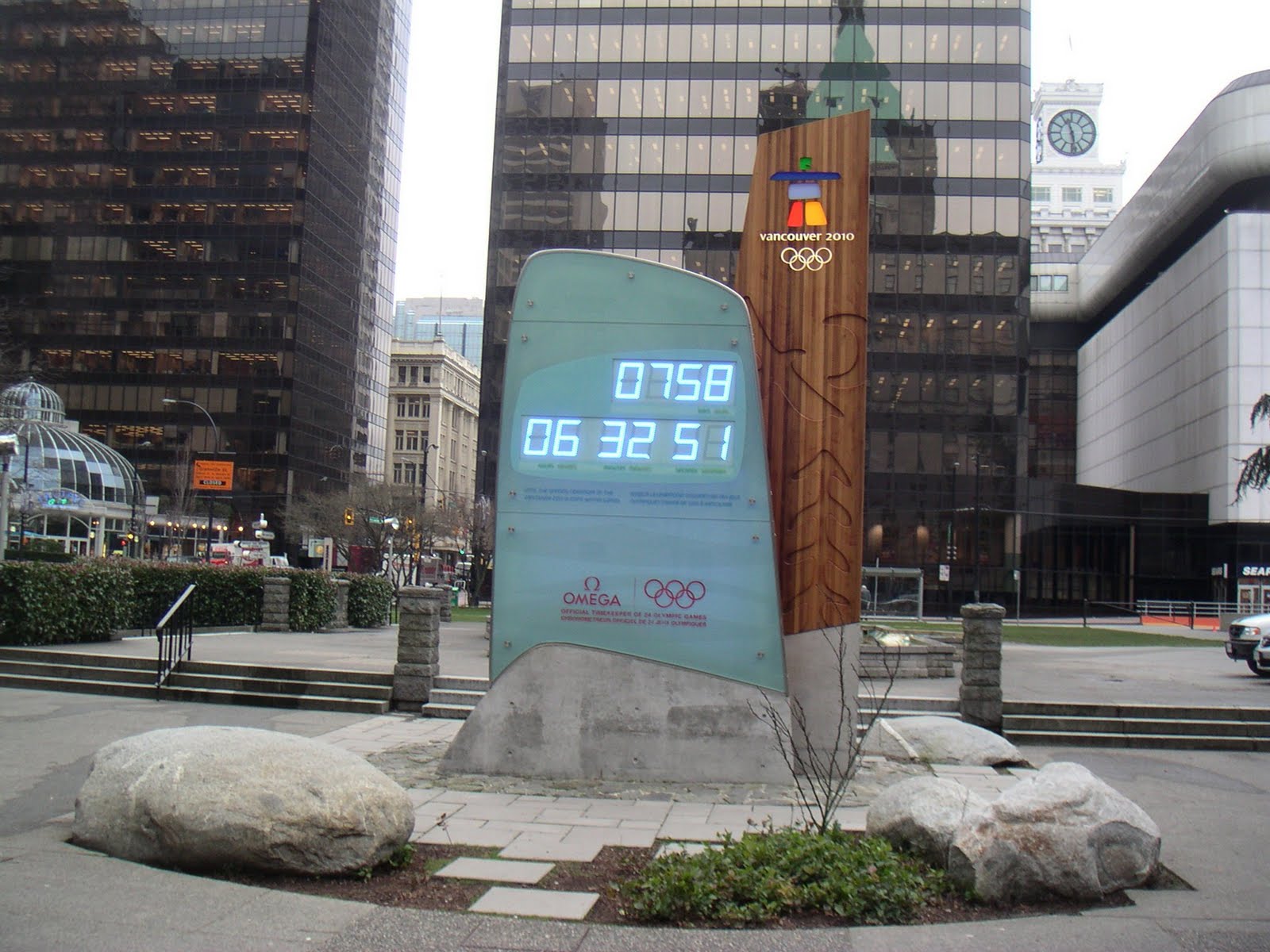 How do you measure anticipation? For the approaching Vancouver Olympic Games, a thermometer may not be the appropriate tool, as it would remain firmly below zero even with the opening ceremony a mere six days away. Clearly, things must be heating up by now - or so we are made to believe. But realistically, here in Montréal, some 3'700km from the Olympic Flame, people don't seem to have warmed much to the event. The section at the Bay department store where the official Olympic clothing line is sold was not exactly bustling with activity when I checked it out a few days ago, and media coverage so far was rather muted - with a short outburst of excitement when Canada's roster for the hockey tournament was announced.
Apart from that, the francophones seem to care, if at all, about the degree of recognition and application of the official language of the Olympic Movement, le français. There is a bigwig, going by the grandiose title of "Grand Témoin de la Francophonie aux Jeux Olympiques d’hiver de Vancouver", who is supposed to enforce the proper use of language during the event. He even got to meet with Canada's Governor General. Of course, the role is too politically sensitive to be assigned to just any fierce separatist Québecois, who would probably raise many a ruckus. So instead, a grandstanding but ultimately harmless retired politician from a certain neutral country was picked. (Apparently, they have run out of jobs at the UN...)
In ROC (Rest Of Canada, should you wonder) however, exicitement about the upcoming sports fest seems to be mounting, the farther west, the more. In Vancouver, they use a countdown clock, which obviously jives with the Swiss mindset as well. When I took a picture of it on my visit in early 2008, little did I know that I would live in the host country by the time the games open. And when I moved to this country, little did I know that I'd spend a grand total of three days in Canada while the games are on. The rest of the time will see me in places where they know winter sports from hearsay at best.
And yet I am merry - in anticipation of red rose service, afternoon tea, dim sum and Cathay Delight. Or, as Olympians would say: Being there is everything.
Labels: Canada, language, sport
# posted by Oli : 17:27
01 February 2010
You can say you to me
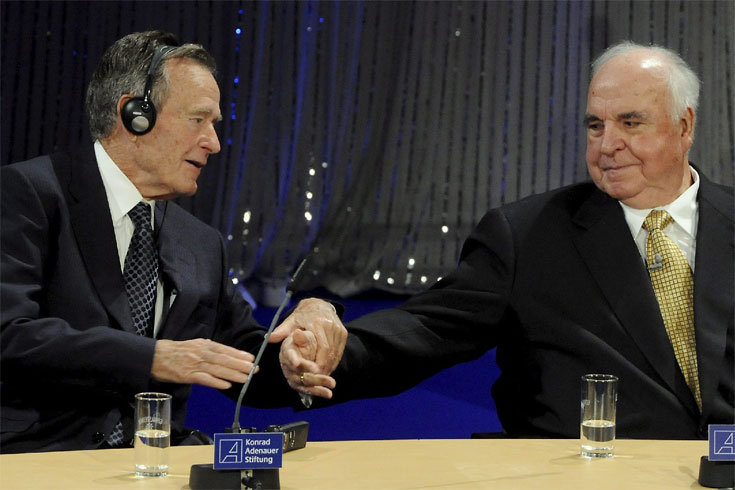 They are admittedly old jokes. Helmut Kohl declaring to US President Bush "you can say you to me", or a terrified French President Mitterrand during a choppy helicopter ride, crying out to Federal Councillor Adolf Ogi "on est perdu!", to which the graduate of Primarschule Kandersteg happily responds "freut mich, ich bin Dölf".
But they do point to a real issue. Both German and French have a formal and an informal style of addressing somebody, the use of which is dictated by complicated implicit social codes. English, on the other hand, has done away with such subtleties a long time ago. This makes introductions and conversations in English much less political, and is probably the reason behind the more casual first name basis so prevalent in English-speaking corporate culture. People brought up amidst the social pitfalls of Goethe's and Voltaire's language revel the liberties of expressing themselves in English.
And then there's crunchtime. In my case, the moment of truth came yesterday, in a most unlikely location: As I was stepping into the changing rooms of my local pool, there were lots of daddies getting their sons dressed (Sunday morning is family time, meaning that by the time I get there in the afternoon, there's even more need for chlorine in the pool). Picking a locker, I exchanged a few English words of courtesy with the mid-forties dad drying off his son there, when I suddenly noticed that he was talking to his toddler in Swiss German. Intrigued, I eavesdropped for a while, but eventually succumbed to the typical expat habit that I had lambasted as annoying and provincial so many times in the past. Still, I just had to out myself as a compatriot!
I made a friendly remark in dialect to the boy, which earned me a blank stare from him but the immediate attention and a smile from his father. "Oh, also Swiss?" he asked. "Yes", was my reply, already noticing the awkwardness of the situation. "Been here for long?" The conversation went on for another two or three pseudo-phrases, with tensions mounting by the second, but let's face it: You can only omit personal pronouns for so long. We had to make a decision: Would we be Sie or Du?
I rescued myself into gesturing at the boy and resorting to the indiscriminate plural Ihr, to which my counterpart flinched and responded with a phrase that started with Sie and ended in Dir. My answer was no less clumsy. We stared at each other for a second, and then simultaneously burst out into laughter. You can say you to me!
P.S. The Economist has recently published a wonderful article on the subject.
Labels: language
# posted by Oli : 20:33


Subscribe to Posts [Atom]


