20 June 2019
Coup de coeur

I thought back to that most perfect day I just had. How could I even verbalize that wonderful, fuzzy, warm sensation? I gave it my best shot. And so I told her.
About starting a sunny and warm June day in Outremont, wandering the leafy boulevards and gazing at the stately mansions, wondering in which Armand Gamache might live. Much like him, enjoying a café au lait and a flaky croissant on Avenue Bernard, reading the morning paper.
About strolling east towards Avenue Parc, past Hassidic students standing outside their Yeshiva, Tora in hand. While they were concentrating on the spiritual teachings the Jews brought to Montréal, having my own mind firmly set on the more earthly pleasures: On Rue St-Viateur, an oven-warm bagel was simply too good to resist, despite firm intentions to save the appetite for another Jewish delicacy: Down along The Main, just before noon, awaited Schwartz's Delicatessen and a medium smoked meat sandwich.
About the indulgence of sitting in a little park off St-Laurent, enjoying said sandwich while watching the world go by: Street artists, businessmen, mothers with kids in tow, lots of twenty-somethings in activewear and bearded hipsters on their fixed gear bikes.
About the ongoing gentrification - or is that hipsterization? - of the Plateau, as evidenced on continued ambles on Rue Rachel, up St-Denis and to Avenue Mont-Royal, the neighborhood's main artery. Chain outlets and somewhat dodgy boutiques have definitely given way to an ever-growing number of craft breweries, microtorréfacteurs and vegan bistros, catering to what seems to be insatiable demand fuelled by the city's new creative class.
About breaking for a little siesta in the shade of Parc Wilfrid-Laurier, to the calm and meditative views of the small pool slowly filling with water, so that the season can begin on la Saint-Jean.
About the reenergizing Bixi ride on the new bike path up to Little Italy, and the first Québec strawberry samples of the season being proffered by the merchants of Marché Jean-Talon there. Vitamin levels thus replenished, indulging in an equally appealing Cannelé and, yes, a locally roasted espresso shot, acknowledging that it is just the thing for whiling away the afternoon while watching the planes from Europe coming in overhead. (Naturally, the one with the white cross on the red tail was right on time.)
About zipping downtown on the métro, to emerge in the heart of the Quartier des Spéctacles, where the Francofollies filled the summer evenings with countless free shows. Sitting down on the lawn, feeling a light breeze on the skin while listening to a young Québec folk singer sharing her travelling songs from journeys across this epic land, and wishing for summer to never end (a hope shared, presumably, by the rest of the audience who had been through yet another brutal Montréal winter.)
About finally heading out to the recently remodelled Parc Jean-Drapeau, where a generous open-air stage abuts a new, wide boulevard linking the métro station to the river, with a panoramic view of this unique city and its Mont Royal rising beyond.
And about the final Bixi ride, across Pont de la Concorde and into the Montréal sunset, elated and grateful for a perfect day in this oh-so-special place.
My friend smiled a warm and compassionate smile. "Well, I think I have my answer", she said. "But you know, when I asked 'How do you like being back home', I had thought of Switzerland...."
Labels: culture, food, leisure, Montreal
# posted by Oli : 20:28

10 April 2018
It's about time

Not a minute later, messages started appearing on the screens in the train, explaining that there was a delay due to "operational reasons". Simultaneously, the conductor came on the tannoy to explain that our arrival would be delayed by a few minutes since a preceding train was still blocking the track at Zurich Airport.
By that time, a lot of huffing and puffing had already ensued with the bleary-eyed commuters around me, with one lady calling someone to explain that she'd miss her connecting bus because that there were "delays again", and that she'd now have to wait another 30min for the next bus.
As she hung up, our train set into motion again. In the end, we arrived at the airport a full five minutes late. I easily made my flight, from which I am writing this now. But to my compatriots, the event surely confirmed their impression of degrading service reliability, and ruined their day early.
Taking the train has been a recurring feature of my most recent trip. Yesterday, I was travelling from Frankfurt to Zurich, using a deeply discounted Sparpreis ticket that restricts users to specific trains - at least in theory. In practice, my first ICE was running over ten minutes late, and when we got to my planned connecting station, I learned that the other train was over 45 minutes behind schedule. The German conductor shrugged and suggested I continue riding the first train all the way to its terminus in the border city of Basel and figure out a way to Zurich from there. By the time we reached Switzerland, station announcements proclaimed that the connecting train had now been cancelled completely. Gone, disappeared, presumably vanished along the tracks with all hands aboard. Die Bahn kommt not, and it didn't much care, either.
The Swiss Railways, on the other hand, immediately mobilized a replacement train from its stand-by reserve in Basel, in order to keep its famed Taktfahrplan intact. This was taken for granted by my connecting countrymen, and we reached Zurich with a delay of a full three minutes. The Germans, including the ICE train staff, were baffled.
Punctuality, then, is as much a cultural as a chronological concept. That in nine years in Canada I have never taken Via Rail already says a lot. But every time I walk across the lobby of Montréal's Gare Centrale on my way to grab lunch, I glance at the big arrivals and departures board hanging from the ceiling. Not only does it show but a handful of trains running all day, inevitably at least half of them also post a delay. And we're not talking five minutes here: Half an hour or more are the norm, with revised arrival times indicated as "estimates". No one seems to mind. "That's just how it is" my colleagues would say. It probably helps that Via Rail's main competitor is an airline that finished dead last in North American punctuality statistics.
The Swiss, then, are both fussy and spoilt with their trains. Yet there is one country that puts Switzerland to shame with its rail performance. That country, to which I had bought a rail pass for this vacation, is of course Japan. In the land of the rising sun, delayed trains would be considered rude and shameful. And therefore, they simply don't seem to exist.
On my entire trip, not one of the many trains departed even a minute late. Whether it was one of the fabled Shinkansen super expresses, or a simple suburban train, they all left smack on time. The entire system is perfectly calibrated for maximum efficiency and reliability, and the Japanese are masters at lining up in the right spots, letting people off first, getting on quickly, and whoosh... we're off.
The latest statistics I found indicate that the average delay for a Shinkansen train was 52 seconds, down from a record 17 seconds in 2007. This is in an island nation with anything from typhoons to blizzards happening, with the occasional earthquake thrown in for good measure. It's mind boggling. Throughout my trip, I saw precisely one sign indicating a delay, prompting instant jokes about that train driver committing seppuku at the end of his shift. Speaking of suicide, urban legend has it that it is dishonorable for Japanese to throw themselves in front of a train during rush hour, since the ensuing delay would inconvenience too many others...
Reflecting on the different perceptions of punctuality will hopefully help me putting things into perspective the next time I find myself on a delayed train. And until then, it will give me new found appreciation for doing things just in time. Or, as they say when the Montréal metro is stuck: D'autres messages suiveront.
Labels: Asia, Canada, culture, Switzerland, travel
# posted by Oli : 12:23
17 March 2018
Pay As You Go

As I have discovered many years ago, Canada operates a tax-withheld-at-source system, meaning that employers deduct the expected income tax amount from each paycheck and remit it directly to the government. Taxpayers then file their returns and, depending on the various tax breaks, credits, subsidies and exemptions they are entitled to, will get some part of these previously withheld taxes back.
When I first learnt about this system in 2010, I saw how it shifts the balance of power towards the taxman. Essentially, the government gets its money up front and doesn't have to run after it with a laborious collections bureaucracy. The onus to file a tax return is on the individual, who will not get anything back unless he completes the annual paperwork.
The above certainly still holds true, but over the years I've come to realize that there is another reason for the tax collection to work the way it does. And that reason lies in the relative financial immaturity of the typical Canadian.
A recent study found that the average Canadian has over $8500 in consumer debt, i.e. not including any mortgages. However, as 46% of respondents reported no debt, this means that the other 54% each shouldered an average of over $15'000, typically in high-interest vehicles such as revolving credit cards and lines of credit.
Another survey, back in 2012, noted that a third of Canadian households lives paycheck to paycheck, i.e. they don't manage to put any money aside at all. The study found the household savings rate at a paltry 3.8% of income, down from 19.9% in the early 1980s.
These are the kind of numbers that make this debt-averse Swiss author pale. But they are indicative of a culture where basic financial literacy is scarce, and discouraged. Start with the tax example: She didn't "make" $5000 by filing her tax returns, she reclaimed money that she had already earned and her employer had withheld in excess. Consequently, a tax refund shouldn't be any more reason to go on a spending spree than a regular paycheck would be. And yet an entire seasonal custom has formed about "what to spend your tax refund on".
Speaking of paychecks, the law stipulates that these need to be issued no less often than every 16 days. Meanwhile, in Switzerland parents switch from handing out pocket money every week to every month when their kids turn 15 or so, in order to teach them financial responsibility. Many Canadians simply wouldn't manage to spread their salary evenly across a month, even though the amount of money per period wouldn't change at all.
Finally, and most egregiously, the government is complicit in the greatest of all deceits, by allowing retailers to advertise their prices without taxes. Time and again, I hear friends talk about this great sofa or that cool gadget that they were able to snag for "only $999". In reality, they spent $1151 on it, with the 15% difference going to the government. But it's cash out the door just the same, no matter how hard both buyer and seller try to deny it.
Which brings us back to the tax system. I understand now that the other reason for it being pay-as-you-go is that too many people simply would not be able to hold on to the cash for deferred payment if they ever got their hands on it. That's a sad and troubling thought.
If there is one place where the Swiss, and Europeans in general, really love pay-as-you-go, then it is with cheap cell phone plans. As any traveller on a shoestring has found out, the best way to stay connected in Europe, Asia and many other parts of the world is to buy a local SIM card, upload a few dollars' worth of airtime, and then use it up bit by bit. In Canada, the oligopoly of three large telcos and their subsidiaries has entirely prevented this customer-friendly pricing concept from taking hold. In the Great White North, home to some of the highest wireless fees in the developed world, "prepaid" plans simply mean that customers must upload money first, and are then still charged monthly fees of $10 or more, irrespective of usage.
In a nutshell, we have financial immaturity, deceitful and inflated pricing, and soaring household debt. Could there possibly be a connection? Let the penny drop.
Labels: Canada, culture, Quebec
# posted by Oli : 16:27
05 February 2018
Need to vent

Or so I thought one night, as I once again dodged her bewildered looks and opened the bedroom window, letting in the icy winter air. As any Swiss, I wanted to lüften the room before going to sleep. And as any Canadian, she considered that sheer madness. I tried to explain, but I was quite literally lost for words.
"To air out" or "to ventilate" are the translations the dictionary lists when I look up the German term. But while that may correctly describe the technical process of exchanging the air in an enclosed space, it falls far short of capturing the cultural importance lüften has to the Swiss.
In Switzerland, lüften happens everywhere, and all the time. Those who don't sleep with their bedroom windows ajar will at the very least open them before going to bed and after getting up. Kitchen windows open after cooking. In school, one student per class is inevitably put in charge of opening and closing the windows, just like someone has to clean the blackboard. In the army, we received detailed orders on the proper lüften of our barracks on day one of boot camp (diagonally across the hall, at least three times a day, no less than 5 and no more than 10 minutes). Until the recent advent of air conditioned train sets, even train windows could be opened to ensure adequate ventilation.
And in Canada? Complete incomprehension prevails. In the summer months, windows are cranked open and left that way for weeks on end. And in the winter they are kept shut. "We are paying to heat up the air in our house" she said sternly. "I do not want to contribute to global warming outside!"
Don't they understand? How can they not be concerned about the stale air inside a home, and want to exchange it for the crisp and pure variety outside? Aren't they afraid of.... well, what exactly?
Unsettled, I turned to the handy Xenophobe's Guide to the Swiss for a neutral perspective. And sure enough, a section in the chapter on Obsessions reads
The Swiss are subject to numerous obsessions. One of the strongest is their preoccupation with air. Inside Swiss homes the uncontrolled movement of air in the form of draughts is detested. The Swiss believe that exposure for even a few seconds to a draught will bring on every ill known to mankind. Thus rigorous efforts are made during the construction of Swiss houses and apartments to eliminate the slightest possibility of a draught ever being allowed in. Yet each morning, they seem to put aside their phobia when they fling open their windows to air their bedclothes out.And suddenly, it all made sense. The Swiss are so fixated on lüften because they are so opposed to any naturally occurring flow of air. Whereas they build their air raid-proof houses with eternity in mind, Canadians take a more relaxed approach to construction: When I sit in our kitchen behind the (closed!) balcony door, I can still feel the cold seeping in. And while we have replaced all the windows recently, the wind blows right through the cracks between their frames and the crooked walls.
I can relax now. There really is no need for a translation of lüften. In Canada, even the oldest buildings do it all by themselves.
Labels: culture, language, Switzerland
# posted by Oli : 21:15
05 January 2018
Try me

As we ambled past bakers, butchers, fruit vendors and the like, she noticed something: None of the merchants offered any samples! Indeed, the little trays so common at Montréal's Atwater market (and many others around the world) were nowhere to be seen. No Swiss vendor deemed it necessary to tempt the clientele with little bits and bites, and no Swiss customer seemed to expect any.
What a difference when we made it to the back of the market, where an Italian cheesemonger was proudly standing behind big wheels of fontina, provolone and pecorino. The moment he heard us speak English, he chimed in with his thickly accented "Ello! Come try formaggio!", sticking out a plate. And when I responded in Italian, he immediately started cutting thick slices of formagella for us to try... and, unsurprisingly, buy.
Unfortunately, this market is not the only place where the Swiss show their stingy - or is it snotty? - side. I vividly remember leading a group of 20 American visitors into the main branch of Sprüngli, Zurich's flagship chocolate store, many years ago. I sung the praises of their signature macarons, Luxemburgerli, which were sitting pretty in their alluring colors behind the counters. The Americans looked intrigued. The Sprüngli staff was unimpressed. When asked how they taste, their answer was: "Very good."
Naively, I thought that a cultural misunderstanding was happening, and sprung into action. "I think they'd be curious to try", I advanced in Swiss German. "Certainly", came the response. "What size of box do you want to buy?"
I was dumbstruck. And then I got angry. "Clearly, this store wants you to buy the cat in the bag", I said, loud enough for all the store to hear. "Let's leave." 20 American credit cards disappeared into wallets again, and we stamped out.
Obviously, things did not change since. Time and again since, I witnessed bewildered tourists at Sprüngli's airport stores experiencing the same obnoxious parsimony. "You can also buy single truffles if you want to try them first" was one of the stand-out lines put to a shocked Japanese once. It's revolting.
And yet... I keep buying those damn good chocolates. And the markets are as popular as ever. Like any good Swiss, I roll my eyes, frown in disgust, and then pay up. For as long as I do, vendors are vindicated. When it comes to free samples, they'll have the last laugh as they say "Just try me!"
Labels: culture, food, Switzerland
# posted by Oli : 13:24
25 November 2017
Hold the line

If only the clinic in question was as technophile as its clients - there must be a smarter way to manage queues. Or is there?
"The line is part of the fun" stipulated none other than Walt Disney, when he set about building his first theme park. He realized that people wouldn't feel the joy of his "happiest place on Earth" if they spent most of their day standing in dull lines, waiting. So his engineers and designers set out to incorporate the zig-zagging line-up areas before any ride into the attraction's theme. Over the years, these pre-ride zones have gotten more and more sophisticated, setting the stage with sounds, sights, videos, props and sometimes even animated characters.
But even basics keep prospective riders entertained: I remember a visit many years ago to the Matterhorn Bobsleds at Disneyland, where the inevitable Swiss theme materialized itself in a cantonal coat of arms being affixed to each pillar of the faux-wood roof covering the waiting area. Unfortunately, Switzerland has only 26 cantons, but the roof had more pillars. So the Disney gang simply continued adding made-up coats of arms to the extra pillars. We laughed so hard that we barely noticed the hour or so spent waiting in line.
Sadly, Walt Disney is dead, and greedier managers have taken over running theme parks. These days. waiting in line is for poor schmucks. At most parks, "Quick Access" tickets allow the more free-spending to bypass queues, skipping right to the front of the line. The price for this privilege is variable: More on busy days, less on slow ones. There are even ticket machines placed outside major rides, letting you buy up from a regular admission once you see the daunting line-up.
This of course means that managers now have different incentives than old Walt did. The less attractive and longer they make the wait, the more likely they are to rake in extra cash from Quick Access tickets. When I last visited a roller coaster park, I endured dull, cattle-like queueing, while giving the evil eye to those rich folks passing by in their dedicated lane - sometimes twice before I got on.
This time, the roles were reversed, for yours truly took the bait and spent the dollars for Quick Access. Sure enough, in a day at Bush Gardens, I got more stomach-turning thrills than ever before. Triple launch coaster, inverted coaster, dive coaster, sit-down coaster, I rode them all. First row, last row, hands in the air. And again.
It was a lot of fun. But something wasn't quite right. It took me a while to put my finger on it, but I finally found the missing ingredient: Anticipation. Not having to wait meant not watching the coaster go by time and again. Not hearing the people scream. Not visualizing every twist and turn. I just ran up the stairs, flashed my Quick Access barcode, and was on. And two minutes later, off again. There just wasn't the time to get anxious and excited, and then to have all that tension release as the train drops from the sky.
Walt Disney was right all along. The wait is part of the fun. It makes you appreciate what you are about to get, and lets you savor it more intensely when it is finally here. So, dear readers, if you thought that the latest post to this blog was a long time coming... you are welcome.
# posted by Oli : 16:59
31 October 2017
Social committee

Yes, Halloween is upon us once again. After initial ignorance, my time in Canada has by now made me well-acquainted, but no more enthusiastic, about the North American version of carnival. It remains an asinine, unnecessary, embarrassing and highly commercialized aberration.
Only recently, though, have I started noticing that the dressing up isn't just limited to rugrats and the alcohol-infused university set. Last year, I was irritated when on October 31st, I was served by a bank teller in a fairy queen outfit (good thing she didn't go for the bank robber look). But this year took the institutionalized silliness to new heights.
A few days ago, a company-wide email from the social committee (the first I heard of such a body) arrived in my inbox, alerting me not only to a communal pumpkin carving in the cafeteria and a ghoulish potluck (aren't they all?), but also officially inviting me to wear my costume both on the day before and on Halloween itself. Ever the cynic, I laughed at the hopeless attempt by company cheerleaders to lighten the workplace mood, and promptly deleted the message.
But as it turned out, many colleagues did not: For the past two days, I have worked side-by-side with cowboys, cops, Hotwarts wizards, and random creations with silly wigs. What seemed utterly undignified to me appeared to be great fun to my - normally straitlaced - colleagues.
For marketers and merchandisers, extracting not just kids' pocket money, but adults' hard-earned dollars for Halloween costumes surely is the holy
Fortunately, in Canada the hubbub will be over by tomorrow. South of the border, though, they are not so lucky. There, a serially bankrupted former Reality TV star has been acting as President since January. Who ya gonna call?
# posted by Oli : 22:08
23 October 2017
Contes des îles

The islands in question are the Iles de la Madeleine, a cluster of 7 sandy shoals located half-way between Prince Edward Island and Cape Breton, inhabited by 13'000 Acadians and a handful of anglophone descendants of shipwrecked sailors.
Despite their remote location, the islands are politically part of Québec. And that held the key for us to get there cheaply: The 3-stop flights that link them with Montréal are considered "intra-province" and as such available for only a handful of frequent flyer miles. And so we clambered aboard an ancient Dash 8 aircraft one sunny fall morning, and soon found ourselves on approach over the sandy dunes.
Sand, indeed, is not in short supply: Over 300km of unspoilt beachline meant that we didn't need to leave our cozy Bed & Breakfast early to put down our blankets at the best spot. Not that they would have stayed there for long anyways: The constant wind, which makes the archipelago a mecca for surfers and kite-flyers, would have swiftly swept them away.
Our visit was at the very end of the short summer season, meaning that many attractions and dining choices had already closed for the year and the weather had gotten too cool for any water sports.
Rather than hoards of German tourists, it was seals and migrating birds that kept us company on our long walks along the water, and up onto the crumbly red sandstone cliffs that mark parts of the shore.
Low tide reveals grottos and caves under these cliffs, and it was there that the most magical of events took place one full moon night: As part of the Contes en Iles festival, torches and bonfires were set up, and storytellers from the near and far set out to spin their yarn in their light. The locals were clearly entranced, and we were enchanted, if by nothing else than the colorful local accent, so different from the grande terre, as they call the mainland.
Which, as it happens, is just as expensive to get to for the madelinots as it is the other way round. While this leads to high prices for goods that need to be ferried in (i.e. everything), it also fosters a close-knit, trusting and welcoming attitude: Houses and cars were routinely left unlocked. At our second visit to the local bistro, the staff started gossiping with us. At the farmer's market, villagers loaded their own baskets with produce and paid in a honor system. This, I thought, must be what rural life had been like everywhere in centuries past.
Of course, recent times have brought some changes (for instance mobile phones in 2003, as the tourist guide proudly proclaimed), including the micro-breweries, cheesemakers, and crafts shops that holidaying urbanites look for in their quest for authenticity. A recent surge in visitor arrivals, albeit still very reasonable, rewards the locals' initiatives.
It is not hard to see how word spreads about these mystical islands with their charming inhabitants. The highlight of our tale about the Hawaii of Québec however isn't its delicious food, or its unique madelinot accent, or even the adventurous way to get there. It is the otherworldly beauty and rough charm of a landscape so different that it has to be seen to be believed.
Labels: culture, Quebec, travel
# posted by Oli : 00:30
31 July 2017
Wild Wild West

Cultural diversity, though, exists even within the WASP bedrock of Canadian society, as I found on a recent jaunt to Calgary. While the western city was mostly associated with the boom and bust of the oil sands industry (Canada's dirty secret) in recent years, its original claim to fame was as a hub for farming and ranching where the endless prairies meet the Rocky Mountains.
It is to this heritage that the town dedicates 10 days each summer, when it hosts the Calgary Stampede, described with signature modesty as the greatest outdoor show on earth. The festival of everything western had been on my bucket list for many years, and what better year than that of Canada's 150th anniversary to make tick it off?
From the moment I stepped off the plane, it was clear that this wasn't Montréal (or Toronto, for that matter): Cowboy hats abounded, boots and bolo ties were everywhere. Hotels had set out mock saloon doors and horse troughs. Everybody wore checkered shirts.
Things got more intense at the vast Stampede park. Apart from the standard fairground rides, there were large sections dedicated to agricultural exhibits (the maize of Manitoba, the berries of B.C.) and stables where prize artiodactyls were groomed, shoed, paraded and judged. Not much of an expert myself, I was impressed by the wide range of bovine cosmetics available.
The real fun, of course, was to see the beasts in action. Professional riders named Cody, Curtis or Clay competed in Bareback and Saddle Bronc riding, where success is measured in seconds on the back of a ferocious bull. Others preferred the rodeo staples of steer wresting and tie-down roping, their looks and skills putting Lucky Luke to a shame. And the most daring harnessed four thoroughbreds to a chuckwagon and raced them around a dusty track, much to the crowds' delight.
More remarkable still than their skills seemed the cowboys' pedigree, if you pardon the pun. These were not Disney performers in funny costumes, but true farm boys from small prairie towns north and south of the border. After the race, they could be seen smoking cigarettes and drinking Bud Lights by their pick-up trucks.
Of course, not everybody in boots and hats had the same stallgeruch: My Calgarian colleague happily confessed that his cowboy gear comes out exactly one time a year for the Stampede, and then swiftly disappears in the basement again. "This little shin dig is our western Halloween", as he put it.
But dressing the part certainly adds to the atmosphere. As I grabbed a watery beer and joined the crowds at the Nashville North scene, where country bands were playing and people were line-dancing, I suddenly realized that at the very least, I should have worn my Edelweiss shirt and the suspenders embroidered with Appenzell cattle. After all, we Swiss are cowboys as well. Yee-haw!
Labels: Canada, culture, event
# posted by Oli : 21:17
12 July 2017
Jukebox

Similar to a jukebox of old, individuals seem to cultivate only a limited personal universe of musical tastes. Studies such as this one argue that adolescence is a particularly important time for forming these preferences, and that once the universe has been established, it changes only very gradually over a listener's lifetime.
Granted, these days the gadget in your pocket can hold many more tunes than the best Wurlitzer ever could, and in theory the internet offers infinite selection. But services such as YouTube and Spotify build on users' tastes and offer more of the same, driving us ever deeper into the limited realm we have a predisposition towards. It is not unlike the news selection bias created by social media.
In Montréal, the festival summer is in full swing (well, jazz, actually) and one of its joys is the opportunity to spend warm evenings aimlessly wandering around the Quartier des Spectacles and letting oneself be surprised by whatever performances are going on at the various outdoor scenes. It is a perfect opportunity to invite serendipity and to discover new acoustic worlds.
And so it was last weekend, when a little misunderstanding meant I found myself in front of a different stage than my friends. But onto this stage leaped a woman who had just come back from a lengthy hiatus. In my formative music years, Lee Aaron was Canada's metal queen. Now, two children and three decades later, she has drifted towards solid rock and blues. With her fantastic voice, vivid presence and great tunes, she catapulted herself right into the center of my attention.
That same night, I downloaded her music and made her a headliner in my playlists. Out of nowhere, a new sun had risen in my acoustic universe - and reminded me how enjoyable it can be to look over the horizon.
But while there are new tunes to sing along, has Lee opened up a new genre to me? Not really. I still love Rock 'n' Roll. So put another dime in the jukebox, baby!
# posted by Oli : 22:11
30 April 2017
Mani talk

This may be an old joke, but it has not lost any of its wit - or its veracity, as we were able to witness on a recent trip to the bel paese. For a sunny spring week, we enjoyed not just the stunning beauty of Liguria, but also the joy of watching Italians... well, be Italian.
I once tried to explain it like this: The Germanic people north of the alps paint their houses white, because they are reserved and conservative. The Latin people south of the alps plaint their houses in gaudy colors, because they are lively and extroverted. And in Italy, that extroversion starts the moment you leave the airport: We were honked at, and had headlights flashed before we even reached the autostrada.
In Parma, kids in the street were fidgeting with palm fronds their parents had received at mass (Palm Sunday and all that) earlier in the day, while in the piazza outside the cathedral, black-robed priests straight out of Don Camillo were using the branches to underline their points like a conductor would.
In the little osteria in Portovenere, the fat owner behind the bar barely talked at all, but with a combination of gestures and expressive mimics directed his hard-working waiters around, while visibly appraising all entering patrons - blonde Canadian women got a nod of approval.
Just as I started to adapt to the beloved Italian way (surprising how quickly foreign swear words come to you when some Alfa Romeo cuts you off), we came across a restrained and strangely non-manual receptionist at a hotel. But I quickly grew suspicious of the accent in his Italian: Sure enough, he was Swiss-German.
At one little convenience store where we filled our backpacks for the hikes along the Alta Via delle Cinqueterre, a cashier petted and caressed a customer's toddler, while at another, two old ladies in front of the deli counter had their hands so high up in the air that I could barely see the salumi behind them.
Not all the gesticulating is friendly: At a supermarket in Genova, we got into an argument with the staff around the price of cheese (yes, loyalty programs were involved) which led to raised voices and those hand movements that you know from Goodfellas and The Godfather - we did not get our cheese.
By and large, though, the handful of Italianità we got to experience was magnificent. Gorgeous landscapes, impossibly beautiful towns, splendid (if strenuous) hikes and delicious cuisine day after day.
Most enjoyable of all, though, was to simply sit in the sun on a promenade, and watch Italians going by. It was thus that we were treated to the observation that reminded me of the old joke: An elderly, immaculately dressed couple was strolling down the street, the man holding on to his wife with one hand and to a cane with the other. Suddenly, they spotted two friends, rising from a park bench and walking towards them. Hugging and greeting ensued.
And then, the man stepped over to the bench, carefully deposed his walking stick, and turned back around to the rest of the group. After all, how could he have talked with his hands full?
# posted by Oli : 16:39
15 December 2016
Winter layers

This cutoff date is obviously way too late, as was vividly illustrated by an absurd car pile-up right outside my office last week, which garnered over 20M views globally and made Montréal a laughing stock for winter preparedness.
But I understand. These are all symptoms of the same condition. Every year, at the beginning of yet another long, dark and cold winter, Montréalers practice themselves in denial. With a combination of wishful thinking and stubborn steeliness, the signs of the season are ignored. When falling temperatures finally put paid to dresses and shorts, we surrender in stages.
The first one is easy: That fall jacket may have spent all summer hanging in the wardrobe, and the airy silk scarf is a fashion statement more than anything. A Stetson hat serves but to protect against fall showers.
Soon, the silk makes way for a cotton scarf, and some leather gloves protect against morning chills. But we'll just slip on a vest under the jacket, and walk a bit more briskly.
It is the first layer of frost that makes the sidewalks slippery, and forces us to upgrade from brogues to the better grip of a trekking shoe. At the same time, with a sigh, the wool coat makes its appearance, and the ears are tucked behind a headband.
In mild years, such as 2015, this stage can last until Christmas. But normally, it doesn't. Every time, though, it takes a few really cold days where Montréalers suffer cold hands, numb toes and - swoosh - sore bums, before the inevitable is acknowledged: Amidst vocal lament, the ski jackets are brought down from the attic, the snow boots are placed on the door-mat by the shovel, and the wool scarf and tuque are reluctantly donned. Fully winterized, we traipse through the glacial city, surrendering to the fact that Jack Frost has once again begun his seasonal reign.
Today is December 15. It is the Day of Reckoning.
Labels: culture, Montreal, weather
# posted by Oli : 21:59
26 September 2016
Paint it White

In Québec, this is not as obvious a decision as I had hoped, for the province combines both exuberant Latin style and North American taste for gaudiness. This leads to many walls, both on the inside and the outside of homes, being painted in ghastly shades of color. Whereas my no-nonsense Germanic taste is for the clean and pure, that is not the norm in the belle province: She's a Rainbow.
If not the entire province, then at the very least I had to convince the better half of a timeless color which does Not Fade Away. White makes rooms seem larger, brighter, more modern and more calm. Why would you want your walls to be in any other color? I don't want my home to be a disco, but to Gimme Shelter.
Love is Strong, and it is not as if I wasn't willing to compromise. Any of a 147 shades of white would be fine, whether it is "Roman Column", "First Star" or even the mysteriously named "Swiss Coffee". But she still had Mixed Emotions.
So before long, we were off to a place where I came close to my 19th Nervous Breakdown: The DIY wonderland that is Home Depot, where tools and appliances pile high into the sky and the home improvement-averse are overwhelmed endless aisles of intimidating gear. My head started spinning, and while she headed straight to the section with the paint samples, I strayed into the lands of piping, floor tiles and kitchen sinks. Soon I was lost. Anybody Seen My Baby?
Luckily, we found both the exit and compromise, because You Can't Always Get What You Want. One wall of our office would be blue (but not turning to grey). The painters moved in, did as they were told, and after a day or two of Ventilator Blues, the paint has dried and our house is now resplendent with brightness.
It's All Over Now, and it is mostly white. At last, I got my Satisfaction.
# posted by Oli : 20:00
31 July 2016
Patriot Day

2016 is the first year I can consider both of these events truly "mine", and it also marks the first time since 2009 that I took part in events for both of them. (Normally, I am on vacation during at least one of the days, but this year I was tied down.)
The Swiss event, the largest such celebration to take place in North America, was held on the last Saturday of July (since August 1 is not a holiday for expats in Canada) and offered the expected mix of folkore, pathos and culinary delights. Unlike the sole other time I drove to the picturesque town of Sutton for it, this year she came along, placing me in the role of a cultural interpreter. Having to explain traditions such as jodeling and lampion parades forced me to reflect on them, and the way the Swiss observe their national day.
The comparison with Canada Day imposes itself, with memories of it still fresh. Granted, the two were not like for like, as the Swiss festivities were those of a sentimental expat community, and the Canadian ones in Montréal's Old Port arguably these of a sceptical separatist province.
Indeed, the official act was repeatedly interrupted by loud demonstrators demanding more rights for First Nations people. While the jeering and booing visibly bothered the military band playing O Canada for the flag raising ceremony, the crowd generally chose to politely ignore the protesters, and the local MP addressing the audience ad-libbed a comment about Canada respecting everybody's freedom of speech.
Most striking, though, was what followed next. While the Swiss tradition may be to light a bonfire warning of foreign threats, the Canadians chose to celebrate by making more citizens. Across the country, a cornerstone of National Day proceedings is a special Citizenship Ceremony, where a lucky group of applicants is invited up on stage, and then sworn in to become subjects of Her Majesty in front of an applauding crowd waving Maple Leaf flags (helpfully handed out by government staffers beforehand).
In the inevitable speeches, Swiss politicians love to recall the story of William Tell and how the valiant Eidgenossen have resisted foreign invaders for over 700 years. Their Canadian counterparts invoke a history of immigration and multi-culturalism, and pride themselves in welcoming more people into their fold every year. (Only cynics would note the excellent opportunity to capture new voters before anyone else does.)
It was a touching and appealing message to listen to, and I would hope to hear similar words from podiums on August 1st. For there was a fine irony in hearing the Canadian politician say that the red and white of the Maple Leaf flag should evoke relief and compassion much like the flag of the Red Cross. Which of course was derived from the Swiss flag.
Labels: Canada, culture, event, Switzerland
# posted by Oli : 22:02
13 April 2016
Think different

It wasn't because of the 8 meters of average annual snowfall (although that sounded good), nor because of the depreciated yen (although that helped), nor even for earning more frequent flyer miles (I redeemed some).
It was to expercience skiing that is different. On previous visits to the land of the rising sun, I was intrigued and amused by the unique ways in which the Japanese do things. Often processes, habits or devices would look completely bewildering at first, only to make perfect sense once you'd understood how they worked. Undisturbed by western standards, Japan has developed its own modus operandi, frequently with amazingly good results.
During my stay at a mid-sized mountain resort, where I was one of but a handful of caucasian visitors, I found many examples of an unconventional approach. From the smart management of equipment rental (punch your particulars and skills into a terminal, store it on your ski pass, then go to a counter where everything you need is waiting for you in your size) to the efficient lunch order process (review available options on big boards outside the restaurant, pick a card with the number of your choice, give the card to the chef, pay for your meal while he prepares your dish, leave), countless interactions were designed in unexpected, clever ways.
Smart design extended to physical infrastructure as well: Chairlifts all came with safety restraints and snow protection hoods that opened and closed automatically. Tiny lockers featured illustrations on how to stow multiple ski and snowboard sets in them. Next to them, air compressors were available to blow-dry wet skis prior to putting them away.
To rehydrate after a day out on the slopes, the ubiquitous Japanese vending machines offer refreshments. The more money you put in, the more lights go on, highlighting which products can be bought with the inserted credit. Should you thirst for harder stuff, fully automated beer pouring machines will tilt your glass at the right angle to ensure a good fill, then stand them upright for a final dash creating a nice foam head.
These quirks provided the entertaining and inspiring backdrop to what was a very enjoyable ski break. The quintessential Japanese friendliness and stellar customer service mentality saw me perfectly taken care of: A lack of English skills did not stop staff from greeting and thanking me everywhere, all the time. And I certainly can't imagine the grumpy attendants manning Swiss chair lifts bowing to me every time I get on or off.
With Hokkaido being famous for the freshness of its seafood, the culinary offerings in the resort did not disappoint. The sea was visible on the horizon from the mountain's summit, and over the duration of my stay I must have eaten most of its inhabitants. To digest, few things can beat a steaming hot thermal bath with a view of the calm winter wonderland outside. No Vodka Red Bull-infused après-ski brouhaha here - just perfectly zen relaxation.
Until you notice the gaudy Hello Kitty and Pokémon stores around the corner. Nippon ni yokoso!
# posted by Oli : 19:28
27 August 2015
Square Dance
 "Was nichts kostet, ist nichts wert" goes a German saying; whatever is free can't be worth anything.
Montréal is challenging this saying every summer, with its countless festivals abounding in free performances of all kinds. But the complimentary entertainment is not limited to the Quartier des Spéctactles, as I found out on a recent summer evening.
I had just gotten off the Bixi I rode home from work, and returned it to the station on the square close to where I live. As I did, I heard a swing band playing. Turning around, I spotted a small stage on the square, featuring a few musicians and a surprising number of locals dancing to the tunes.
The town square harbors a little park, complete with a statue and a small pavillion. For at least as long as I am a resident of the area, it also hosted a semi-permanent population of homeless people. And while they were never really aggressive, they were often drunk and their jeers and begging did not invite one to linger.
That changed this spring, when the square reopened after a major revamp. The city has invested in enlarging it, rearranging the surrounding bus traffic, adding new pavements and benches, upgrading the lights to colorful LEDs, and opening a seasonal coffee shop in the rotunda. They even threw in free WiFi. Crucially, they also worked with the police and the charitable arm of the YMCA to find a better home for the itinérants. Overall, it was a job surprisingly well done.
But how about that dancing? That's where Montréal's charm comes into play. In early summer, I found a booklet in my mailbox that detailed a jam-packed 3 month program of events celebrating the revitalization of the square. From open-air cinema to puppeteering, from magicians to tai-chi and from gardening classes to yes, dance nights, the city offered an abundance of free activities all summer long.
I smiled as I watched my neighbors swing the evening away. This was one of these frequently conjured up moments defining Montréal's joie de vivre. All these activities were offered by the city as a matter of course, and welcomed by the residents in much the same way. It is hard to imagine an equally lavish schedule of performances taking place on a similar occasion in another city.
Judging by the many happy faces, and the alternatives, it seemed like a good investment. For of course, the German saying still holds true: The Sultans of Swing did not play for free. While the residents shook a leg, their tax dollars were hard at work.
Labels: culture, leisure, Montreal
# posted by Oli : 21:57
16 July 2015
All that jazz

It may well be the best summer ever. For Toronto. In Montréal, of course, that's every summer. One of the consequences of the high-tax, big government policies of Québec is the largest per-capita spending on arts and culture in Canada. And that materializes itself in the summer-long parade of events which set the city abuzz.
The Jazz Festival is the world's largest, and its reputation reaches far beyond the province's borders. Indeed, it went as far as London, where last year the Economist took note and highlighted a side of the event that had not occurred to me: Apparently, this festival alone generates about $75M in revenues for the local tourism industry. Add to that the happenings before and after it, and you end up with a nice boost to the city's economy.
Given its otherwise uninspiring economic performance, Montréal can use the leg-up, and it is encouraging to see that the "festival season" keeps expanding. This year, I have attended both the C2MTL creative shindig and a rowdy Montréal Complètement Cirque performance. And that's before Just For Laughs brings one of my favorite actors on to the local stage.
To make all of this a success, it doesn't just take lots of tax money, but a thriving local arts scene and a population willing to engage. It is the last bit, apparently, that Toronto is struggling with. When we visited the Queen City last weekend, its inhabitants seemed notably indifferent towards their supposedly sensational summer. The Pan Am organizers rushed to give out free tickets to events, so that at least some spectators would show up for the competitions. Free concerts drew modest crowds.
As Montréalers, of course we would not want to be smug about Toronto's estival tribulations. Magnanimous as we are, we encourage T.O. to seek an extra boost to the provincial bottom line this summer. Staging large-scale sporting events is an excellent way of doing that - as Montréalers had to find out back in 1976.
Labels: culture, event, Montreal
# posted by Oli : 22:32
01 July 2015
Eataly
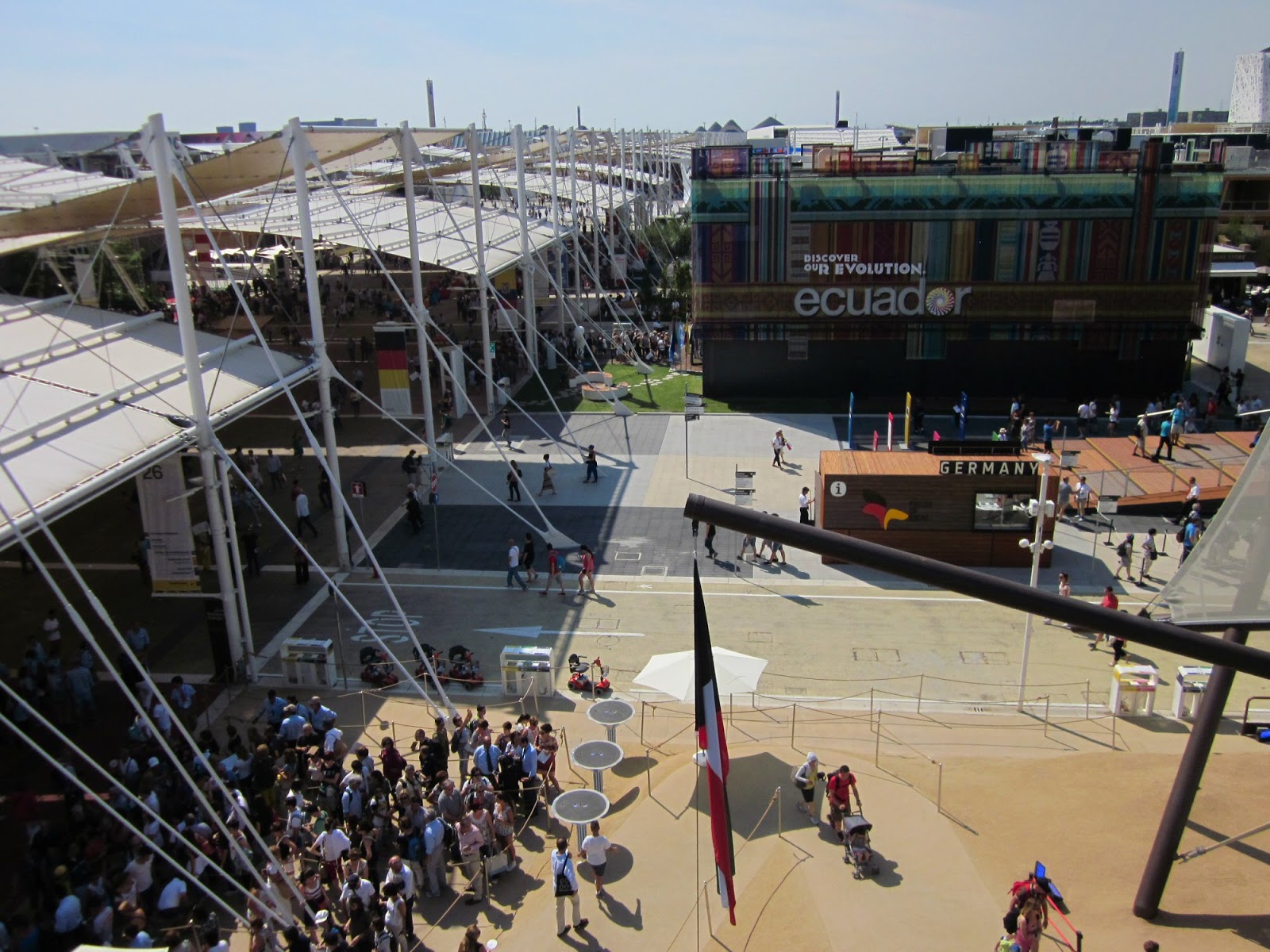
It is easy to name things that Italy is not good at. But it is just as easy to name the one thing where the boot-shaped country's supremacy is universally recognized: food.
Very appropriate, then, that "Feeding the planet. Energy for life." is the motto of this year's World's fair taking place in the northern Italian metropolis of Milan. And very obvious that the foodie writing these lines could not miss out on the chance to take a bite out of it.
The only previous Expo I had visited was in Japan, and it was a futuristic and meticulously organized affair. I was not expecting the same level of professionalism in Italy, and when the delayed train dropped us off at long security check lines, I saw my foreboding confirmed.
But I was wrong: Once through the (very
Even more abundant, though, was the manifestation of the fair's motto: food! For participating countries, universal expositions are excellent opportunities to polish their image and showcase their attractions. In the event, all the pavilions first invited visitors to walk through a more or less thoughtful exhibit on the future of food, before inevitably leading them to the meaty part, as it were: the restaurant and shop.
This provided us with the delicious chance to eat our way around the planet in the course of a single day. Starting with an Italian cappucino and croissant in the coffee cluster, accompanied by a little chocolate from the adjacent cocoa cluster, we grazed our way through French bread, Spanish ham, Chinese tea, Turkish hazelnuts, British honey and Chilean empanadas. In the 30 degree heat, we passed on the Swiss fondue and American burgers, and instead returned to Italian gelato in the afternoon, with another espresso shot to keep us awake.
Before we knew it, and sadly, before many of the evening activities kicked off, it was time to head back to the train station. But not before a final stop at the Future Food District, a high-tech supermarket where we stocked up on organic cold cuts, raw milk cheese and whole grain bread for our dinner on the way home.
As the sun set on a long and memorable day, we did not feel much smarter about "Feeding the planet. Energy for life." But we did feel very well fed by the diversity our planet, and Expo, has to offer. And while we were impressed by the culinary exploits of many participating countries, it was the delicious charm and flavor of the hosts' dolce vita that makes us want to come back for seconds. A presto, Eataly!
# posted by Oli : 12:19
20 February 2015
What they see is what you get

„Jag
talar inte svenska“
I said again, smiling politely into another pretty Blonde’s face.
The shop assistant in question had just explained to me the latest
special offer pricing at the Nordiska
Kompaniet
department store. And she looked genuinely surprised when I had to
tell her that, apart from this single line (and a few Ikea product
names), I did not actually speak any Swedish.
A similar confusion did not arise a few days later, fortunately, when I walked into Bangkok’s Siam Paragon mall. It was Valentine’s Day, it was a weekend, and it was the beginning of Chinese New Year, which meant that the place was absolutely teeming with local shoppers. Of which I was very clearly not part – for my appearance would pretty easily let me pass as Scandinavian, but definitely not as Thai. The best I could hope for, in long linen pants and sans the tourist accoutrements of fanny pack and camera, was the expat look.
Nor do I make for a very credible Turk, young or otherwise, as the subsequent visit to the Grand Bazaar on the Bosporus proved. Istanbul is a popular tourist destination, and consequently, the stall owners and restaurant touts tried their best to guess just where I was visiting from. “Hello how are you? Deutsch Deutsch? Nederlande? Rossiya?” they shouted, before resorting to “where are you from?”
“Québec!” is my typical (and truthful!) answer, which usually bewilders people long enough for me to escape inflated prices and so-called special offers. Answering in Swiss German has a similar effect.
People are easily fooled by appearances, and what they see is what you get. In Stockholm, I was treated like a local, from bus drivers talking to me about traffic delays to hotel staff at check-in – even when they had my Swiss ID in their hands. If, like me, you understand some Swedish but can’t speak it much, this constellation allows you to decide if and when you reveal your true tourist self, rather than just nodding and shuffling on.
This option was unavailable in Bangkok, where people gave me that tired “yet another one” shrug of a city that had seen more than its fair share of ill-behaved Western visitors, or in Istanbul, where I was quickly identified as a walking ATM to be taken advantage of, be it by merchants, restaurant owners or scam artists. I had to keep my guard up.
Such stereotyping can be annoying, but I am the first to admit that I am as guilty of it as the next man. How many times have I seen Asian- or African-looking people walking the streets of Montréal, and have assumed that they must be visitors? Why on earth would they come visit in the middle of winter? I had often wondered. How many times have I mistaken a resident for a tourist?
Fortunately, I blend in with the crowds in my adopted home town. And with almost six years of language immersion under my belt, even the Québecois rarely identify my French as European. My most recent trip has once again nourished my lust for travel to foreign places, but it also made me rediscover the soothing comforts of returning home. For when I am back on the Montréal metro tomorrow, chatting with strangers in the local slang about yet another service interruption and the Sainte-Flanelle’s inglorious performance the other day, they don’t think twice about where I am from. It’s plain to see – here I belong.
A similar confusion did not arise a few days later, fortunately, when I walked into Bangkok’s Siam Paragon mall. It was Valentine’s Day, it was a weekend, and it was the beginning of Chinese New Year, which meant that the place was absolutely teeming with local shoppers. Of which I was very clearly not part – for my appearance would pretty easily let me pass as Scandinavian, but definitely not as Thai. The best I could hope for, in long linen pants and sans the tourist accoutrements of fanny pack and camera, was the expat look.
Nor do I make for a very credible Turk, young or otherwise, as the subsequent visit to the Grand Bazaar on the Bosporus proved. Istanbul is a popular tourist destination, and consequently, the stall owners and restaurant touts tried their best to guess just where I was visiting from. “Hello how are you? Deutsch Deutsch? Nederlande? Rossiya?” they shouted, before resorting to “where are you from?”
“Québec!” is my typical (and truthful!) answer, which usually bewilders people long enough for me to escape inflated prices and so-called special offers. Answering in Swiss German has a similar effect.
People are easily fooled by appearances, and what they see is what you get. In Stockholm, I was treated like a local, from bus drivers talking to me about traffic delays to hotel staff at check-in – even when they had my Swiss ID in their hands. If, like me, you understand some Swedish but can’t speak it much, this constellation allows you to decide if and when you reveal your true tourist self, rather than just nodding and shuffling on.
This option was unavailable in Bangkok, where people gave me that tired “yet another one” shrug of a city that had seen more than its fair share of ill-behaved Western visitors, or in Istanbul, where I was quickly identified as a walking ATM to be taken advantage of, be it by merchants, restaurant owners or scam artists. I had to keep my guard up.
Such stereotyping can be annoying, but I am the first to admit that I am as guilty of it as the next man. How many times have I seen Asian- or African-looking people walking the streets of Montréal, and have assumed that they must be visitors? Why on earth would they come visit in the middle of winter? I had often wondered. How many times have I mistaken a resident for a tourist?
Fortunately, I blend in with the crowds in my adopted home town. And with almost six years of language immersion under my belt, even the Québecois rarely identify my French as European. My most recent trip has once again nourished my lust for travel to foreign places, but it also made me rediscover the soothing comforts of returning home. For when I am back on the Montréal metro tomorrow, chatting with strangers in the local slang about yet another service interruption and the Sainte-Flanelle’s inglorious performance the other day, they don’t think twice about where I am from. It’s plain to see – here I belong.
Labels: culture, language, travel
# posted by Oli : 22:47


Subscribe to Posts [Atom]


