21 January 2017
Prime Time

Cunningly, though, the e-commerce giant also offered to send the book for free within two days, if I signed up for a free 30 day trial of its Prime subscription service. This will then start costing $99 a year on day 31, should I forget to cancel in time.
Instead of paying for shipping, I signed up for the trial and set myself a reminder to cancel at the end of the month. Little did I know that this would change my daily routine far beyond receiving free shipping.
Immediately after enrolling, an email arrived in my inbox welcoming me to Prime, and highlighting the many features the service has evolved to include. Front and center is a gigantic amount of free digital content to stream, from music to movies to TV shows, the latter including the series that Amazon has started producing exclusively for its subscribers.
The only time I had previously heard of Amazon's own film studios was at the announcement that the three intrepid Brits behind the BBC's Top Gear were moving over there, putting a new label on their highly successful motoring show. It is now called The Grand Tour and sure enough, was included in my subscription. So perhaps I could watch an episode or two?
Fast (indeed, very fast) forward two weeks, and I have caught up on the 11 episodes made available so far, and am eagerly waiting for the next weekly release. And I haven't stopped there: A friend recommended the dystopian The Man In The High Castle, set in a world in which the Allies had lost World War II and the United States is now split between the two victorious powers of Nazi Germany and Imperial Japan. The show is brilliantly adapted from Philip K. Dick's novel, lavishly produced and instantly addictive.
Inevitably, in these cold grey January days, we have become true couch potatoes, curling up every night in front of the tube for a new episode. Or two, for in the days of streaming content, the viewer decides when and how much to watch.
So Amazon is clearly very smart in offering these free trials - the digital content is extremely engaging and boosts customer "stickiness", while data shows that once people are signed up to Prime, they will buy a much wider selection of products at Amazon, and become less price-sensitive.
Will it work for me? The TV shows are a tasty bait. But I will still cancel my membership at the end of the trial month. After all, it started when I bought a travel guide. I need time to read it. And soon, I'll embark on a Grand Tour of my own.
Labels: media, technology
# posted by Oli : 16:47

24 November 2016
Uberholspur

Today, I met Ivan. Or Evo. Or possibly Evan; it's hard to say from the scribble on the paper receipt he handed me at the end of a 20 minute, stop-and-go, round-about slog through Montréal's downtown in his beat-up taxi, whose passenger seat was covered in suspicious stains. While this guy didn't speak a word to his customer, he yapped on his phone non-stop.
Gustavo, Guy and Juan are part-time Uber X drivers. None of them considers driving a taxi to be their life's vocation, but they all told me how they appreciate the ease and flexibility of making a few extra bucks when they want to. They know that at the end of each trip, I will rate them on a 5-point scale, and they clearly make an effort to provide 5 star service. Similarly, they will rate me, giving me an incentive to be just as personable.
Uber has revolutionized the transportation business, and in the process has become the best-funded Sillicon Valley start-up company ever. It smartly connects supply and demand, prices competitively but dynamically, and uses technology and peer reviews to ensure excellent standards of service. It is also very convenient for business travellers: Passengers link their credit card to the app, with trips being billed automatically. Gone is the frantic search for (often foreign) cash, and instead of illegible paper scraps, the company sends perfectly formatted email receipts that can go directly into expense reporting.
One can now hail an Uber in nearly 540 cities around the world, and I have done so in many countries, often grateful for the way in which the app helps overcoming language barriers.
Of course, I also use Uber in Montréal, but not as often as I like to. It is not by choice that I end up in the taxis of Ivan and his ilk, but because of their effots to block the newcomer at every turn. In a typically French attempt to block progress and innovation, and defend entrenched monopolies, taxi drivers have been staging demonstrations, blockades, and even acts of vandalism against UberX vehicles throughout the summer. In none of their arguments did "customer preference" ever matter.
In an effort to find a compromise, Québec's provincial government has now agreed on a 12 month pilot project, under which UberX becomes more regulated (and more expensive), but is officially sanctioned to operate, although prime spots such as airport pick-ups remain off limits.
The increased paperwork requirements under the deal has led to a - hopefully temporary - drop in UberX drivers active in the city, which is how I ended up in yet another shabby taxi today. But in the longer term, the superior product will likely prevail.
Gustavo, Guy and Juan struggled to believe when I told them of the intimidation and vandalism their peers in Montréal have to deal with. Here's to hoping that even in Québec, Uber's innovative disruptors will soon see the obsolete taxi fleet fade in the rear-view mirror.
Labels: Quebec, technology, travel, USA
# posted by Oli : 22:36
01 July 2014
Cloud Computing

Thanks to the marvels of modern technology, not only am I connected to the world wide web, there is also live TV available on the screen in front of me. Which must come as a relief to those of my fellow passengers who take an interest in 22 people (just over 2 rows of economy class seating, come to think of it) running after some ball on a pitch in Brazil right now.
The technology nerd in me, not to mention the occasional business traveller, is obviously inspired by the possibilities. I am catching up on personal email left unanswered during my vacation in Switzerland. I check the weather forecast for my return to Montréal. I can even track my flight in real time, including its rather significant delay, and explore possible alternative connections from Toronto should I miss my Rapidair flight.
So far, so good. But is this ever more ubiquitous connectivity really for the better? As the flight drags on, the temptation grows to start looking at work email - never mind I'm only returning to it tomorrow. And although it is supposed to be blocked, I am sure there is a way to use the broadband link to make VOIP phone calls - the prospect of which I dread more than that of a crying baby in the row behind me.
For without wi-fi, what would I do right now? Yes, I could possibly still write this blog entry for a later posting (power plugs on planes are not that new). More likely though, I'd do what I had planned to do prior to discovering the wi-fi sticker on the bulkhead: Sit back, order some Turkish coffee, and read the book I'd been meaning to devour for months now. It's bad enough that I don't find time for that on the ground, now I don't even do so above the clouds. Perhaps, then, the much talked-about move of computing to the cloud is not so blissful after all? Without it, even the news of my team's overtime loss on said pitch would not have reached me for another 3357km.
Time to unplug, then. I can still get a few chapters in. And some more of that Turkish coffee, too.
Labels: technology, travel
# posted by Oli : 14:45
16 February 2014
Generation Access

I hadn't seen the man since I was a child, but my dad had heard about his fellow alumnus' Montréal trip, and had set us up for dinner - which turned out to be highly entertaining and inspiring.
In his illustrious career, this distinguished gentleman has worked in key positions across Switzerland's retail, financial and media industries. Endued with curiosity, perceptiveness and clarity of thinking, he has seen the economy change around him. And probing my urban lifestyle, he summarized the differences between his and my generation much more succinctly than I ever could have.
"Your father and I, we largely measured our progress by the number of things we acquired", he confessed, with an allusion to the six cars in his garage. "But look at what you do. That's the future!"
Between apéro and entrée, I had been explaining how I enjoyed the "asset-free" life I've been living since moving to Canada. I rent cars when I need them, share bikes, exchange books and borrow movies online instead of buying DVDs. I access my favorite music through streaming, collaborate on travel guides, and simply tap into other people's vacation homes instead of owning a cottage.
All of it had just seemed obvious to me, but it was not before this recent dinner that I've realized how much this change in values will impact the commecial realities we know. For my parents' generation, owning stuff was key: The difference between men and boys is the price of their toys, as the saying would have it. This attitude didn't just produce companies such as Hammacher Schlemmer, but also drives luxury car, fashion and real estate businesses around the globe.
If my friend is right, then these industries, which appeal to the post-war hoarders, will face a challenging future. Indeed signs are multiplying that the young urban generation values rapid accessibility and "no fuss" more than an owner's bragging rights. Companies such as AirBnB, ParkCirca and Renttherunway let urbanines access beds, parking spots and fancy dresses, respectively - and that's just the tip of the (shared) iceberg.
For once, then, I seem to be an accidental trendsetter. Right now, I am about to access the latest on-demand video of the Olympic Games. And I will feel smugly superior to those athletes. In this day and age, how can they still want to own these medals?
Labels: culture, technology
# posted by Oli : 21:51
03 November 2013
Expat

What sounds like the beginning of a corny joke is in fact a rather frequent occurence in the life of expats, these rootless roaming warriors of the globe, who live their lives far away from the green green grass of home. It's a lifestyle with lots of perks, but it does not come without downsides. Apart from the obvious occasional bout of home sickness, expats frequently struggle to properly immerse themselves in their current host culture, and to make friends among the local population, lest they get attached to someone they have to abandon again soon.
It was partly out of fear of staying in a glitzy, but transient expat bubble that I tried to avoid fellow foreigners when I first arrived in Montréal. Instead, my efforts centered on building a network of Québecois friends, who over the years provided me with a great introduction to life in the belle province and enabled many of the adventures you have read about here.
Perhaps it was the sense of detachment and superficial commitment experienced during my six months in Chile that helped me open up towards the expat community. Shortly after my return to Montréal, a friend introduced me to an online platform specifically geared towards global nomads. InterNations not only has a wealth of information, bulletin boards and resources on most major cities, it also facilitates regular community meet-ups for networking, and plenty of social activities.
Before I knew it, I had started attending these monthly gatherings on a regular basis, and have seen my connections multiply across a panoply of nationalities. To my own surprise, my almost five years in the city made me one of the more experienced expat residents, and enabled me to help out many of my new acquaintances with their questions on settling in. On several occasions, I directed fellow InterNations members to these pages for reference, from how to get a driver's license to obtaining your immigration physical.
Nonetheless, it caught me by surprise when one of the community members suggested I list this humble diary as a featured blog in InterNations' Montréal section. But why not? Communities such as this one are all about sharing knowledge and learning from each other. And this is why you will now notice a small "featured blog" banner on the right-hand side of this page. A cordial Bonjour-Welcome to all new readers!
I am happy to have joined the InterNations gang, and should probably have done so a lot earlier. After all, I had long been an active participant in a certain other, specialized online community which has impacted my life in more ways than I can think. Including getting me to join a German and an American in a French bar in Hong Kong.
Labels: culture, media, Montreal, technology
# posted by Oli : 11:34
19 January 2013
Android

But no more. As of this weekend, I am firmly tethered to an Android device. And just as a Borg assimilation would, it has already started changing my life.
If for the better is hard to say. But it certainly brings a great range of new possibilities. The nifty phone connects to Wifi, talks to satellites to find out where it is, synchronizes with everything I have stored on my computer and even controls my stereo system. It locates the nearest Bixi station, let's me video-chat with Europe and checks me in for flights. It would even count the calories in my shopping basket - but I don't.
Do I really need a device to tell me that I am standing at the corner of my street, you may ask. Is it really necessary for me to be able to turn on the radio at home while I'm on the bus to get there? And have I really missed seeing a picture of the person calling me when the phone rings?
No. I never did. But it is mighty cool. And so I am now going down that path that I have mocked others for treading so many times in the past: I am fabricating my justification for owning a gadget. It saves me firing up my laptop for every little message. It's great when travelling. It combines the functions of the traditional phone with my beloved Palm Pilot (RIP). And most importantly, it spares me the sorry looks from my entire social sphere.
So there you have it. I have surrendered. And now, if you'd excuse me. I need to recharge.
Labels: technology
# posted by Oli : 17:59
29 February 2012
Untouchable
 "Why don't you just download the app?", asked my friend. It was late last Saturday night, and we had just entered another art gallery participating in Montréal's Nuit Blanche. On display was a rather underwhelming video installation of a man in a sewer. That was, however, merely the most obvious part of the project. As it turns out, the display was linked to a virtual reality environment, which allowed you to wander through the tunnels yourself - on your smartphone. Or at least this is what I understood from my friend, before she plugged in her headset and started wandering the snow-covered streets of the old port, believing to be in the sewers underneath.
This is the same friend, by the way, who had tought her phone's voice assistant to refer to me as "her husband". Fortunately, her boyfriend was in on the prank, and I was touched by the gesture. My phone, however, was not.
In fact, it hardly saw any use that long white night, unlike its much smarter siblings. Be it at the dinner table, directing us from one venue to the next, or updating the social network as we went along, the fruit-branded devices were always at my friends' fingertips.
And if they were not, then they sat there on the table, putting the entire world within an arm's reach. Exactly as they do in any meeting I attend at work these days. Whether it is in an attempt to be more efficient, or just to emulate corporate bigwigs, colleagues across all levels seem to have gotten their hands on a smartphone. An IT guideline on how to connect private devices to our corporate mail servers has recently been sent out - to my PC, that is. I took a hands-off approach.
Not that the benefits completely slip from my hands. On my recent trip, my wingman usually activated his device in the split-second between our plane's main and its forward landing gear touching the ground. By the time we reached our gate, he had published his location on Facebook, checked our connecting flight information, messaged back home, and searched for recommended food outlets. I, on the other hand, was contemplating if it was even worth keying in the PIN code to activate my phone for the short time we were there.
When I got my first handy, over 15 years ago, my friends laughed at me. Who would ever need such a clunky contraption? What was wrong with a payphone? Today, they point their fingers at me - and then at the screens of their pocket-knowitalls. Thinking, navigating, socializing, playing, it all happens with a gentle touch. And rumor has it they can still make calls, too. The marketeer in me rejoices over data trails as rich and as personalized as these. But personally, I have so far remained unimpressed. Will I be able to resist for much longer? I keep my fingers crossed.
Labels: culture, technology
# posted by Oli : 20:33
11 January 2012
Escalate
 The Montréal metro is a marvel of technology. Or at least it was, back when it was inaugurated in 1966. Unfortunately, since the sixties, very little has changed in both stations and trains. Consequently, a ride on the metro transports you straight back to the time of orange, round shapes, tiled floors and green-dot displays. There is ongoing talk of renovations and even new rolling stock, but so far, the only sign of innovation was the 2009 introduction of the RFID-based Carte Opus.
The creators of the city's subway built it to Canada's harsh winter climate: The entire 70km of tracks is indoors, so as to protect the system from snow and ice. Unfortunately, either by accident or by some design that is too clever for me to comprehend, the entire network also seems to be completely devoid of ventilation. Heavy doors shield each station entrance from the outside, and there appear to be no air stacks at all. Which results in an ambient temperature in stations and trains (no air conditioning in the sixties, remember!) oscillating between a sudatory 38C in summer and a no less absurd 25C in winter.
In other words: On an icy day like today, the difference in temperature between the street and the station can be close to 40 degrees. All that separates these entirely different climate zones are a few meters of escalator between the station entrance and the platform below. And on those escalators, nimbleness is key.
On the stairs moving down, red-cheeked survivors unzip jackets, remove balaclavas and start digging for their Opus cards in their pockets, praying to have the tickets ready by the time they are deposed in front of the fare gate.
Escalating upwards, the stakes are higher still. From the moment you step on the travelator, the clock is ticking and the mad dash to get ready for the cold is on. I have gradually optimized my sequence of movements for stowing my magazine, tying up my scarf, putting on my tuque and slipping into my gloves, just in time to push open the air-tight door and brave the cold.
There is no margin for error: If your zipper gets stuck or your shoelace comes undone, you're sent off to the penalty box - the little alcove between escalator and door where you are left to fix yourself up in the company of equally clumsy fellows. But look at it from the bright side: You've just been offered the very best vantage point to marvel at Montréal's bi-directional escalator ballet!
Labels: culture, technology
# posted by Oli : 20:19
10 July 2011
Quebec Lima Hotel
 ...are all letters in the ICAO phonetic alphabet, and as such regularly used in aviation. Not with passengers, of course, but in radio communications and standardized commands on the flight deck, both of which I got to experience first hand on my last flight from Zurich to Montréal. This having been my 10th time on my trunk route of LX86, I had thought that I had seen it all, until the opportunity presented itself to fly along at the very front of the plane, courtesy of a fellow university alumnus turned pilot.
Suddenly, there it was again, that tingling sensation, that fascination with technology and big powerful toys that first attracted me to this industry. As I strapped into my jumpseat on a sunny Swiss morning, relaxed and with my social batteries recharged after a week's vacation, I was giddy with excitement. Never mind the lack of legroom, the limited recline and the absence of a personal TV. Instead of a charming flight attendant, two friendly pilots welcomed me on board and ran me through a slightly different safety demo ("if we have to abort take-off, please stay out of our way"), before providing me with a properly noise-cancelling headset plugged into the best version of Channel 9 I ever got. And before I knew it, we were off, my friend pushing the levers forward and catapulting our craft into the air. Unlike in a passenger seat, the panoramic view through the big windows up front, combined with the airspeed indicator and the end of the runway rapidly approaching, brings back the thrill of this moment. Knowing about the 52 tons of highly flameable jet fuel that accelerate along with the 228 souls on board is not helping - and yet the manouever is routine. We overcome physics, and soon merge into the transatlantic highway.
Cruising over the Atlantic, there is time to chat and exchange knowledge. I learn a lot about just what it is pilots actually do (not this), and in return can shed some light on how my trade helps keeping many an airline flying. And before I knew it, we had burned through most of our fuel, initiated our descent through a layer of clouds and were welcomed by a freshly washed out view of the ile de Montréal. As my friend gently put the 150 tons of aircraft down on Dorval's runway 24R, I wished I had moved to a place more flight hours away. And I had regained quite some appreciation for the diligent work performed by airline pilots every day, enabling people like me to trot the globe as I do.
For of course, Quebec-Lima-Hotel are not just random letters. They also neatly describe my most recent jet-powered displacement. After only a week (and yet, two national holidays spent in the respective country), I became airborne again and, in a roundabout way, reached the Lima hotel room from which I am typing this. I am in Peru to investigate the local consumer market, and from the little I've seen so far, it's a challenging environment. But I may be wrong, and if there is one thing I have learned, it is to hold your judgement until you've gotten the inside view. Make straight in!
Labels: technology, travel
# posted by Oli : 18:14
12 January 2011
Unplugged
 At first I thought it was just your typical big city rudeness. That self-absorbed and abrasive attitude, usually associated with New Yorkers, had probably spread northwards to Montréal. And my fellow city dwellers presumably just found it cool to obstruct my way, to keep standing when I walk up from behind, to ignore the subtle noises and harrumphs, to feign ignorance of other people's presence in public places.
But then I travelled. And as I did, I noticed much the same behavior in other cities, including the Swiss one I used to call home. I was puzzled. What had happened? Had the world just collectively lost sensibility and sensitivity? Was it no longer basic courtesy to move aside for others approaching? And why did they all startle when I eventually pushed past them? Was I surrounded by zombies?
Not quite, a closer investigation revealed. But I wasn't far off the mark, either. As it turns out, most urbanites these days engulf themselves in an auditory bubble. Look closely, and you'll see two white cables running from their ears to a pocket somewhere. That's the sign! They are i-solated. I-nconscient of their physical surroundings. And i-ncredibly i-rritating! Thankfully, it seems as if at least the annoying habit of singing along to what's playing in the personal bubble has grown somewhat out of fashion. in the 90ties, the heyday of the walkman, this was so common that it even inspired a quiz show, Tram Caruso, on my favorite radio station.
My own life continues mostly unplugged. Although I have won one of these i-things at a trade show last year, I've barely used it so far. With the exception of specific situations like a plane ride or a run, the notion of engulfing myself in my own sound has never quite rang true with me. I'd much rather ride the metro reading my newspaper or, even better, watching and listening to other people. If they'd still be talking, that is. As it happens, I'll have to devise my own little quiz show: Based on age, gender, attire and number of head bobs per minute, what could be playing in a person's bubble? And how many times will I have to nudge until I am finally let through? Unplug and play!
Labels: culture, technology
# posted by Oli : 21:31
19 April 2010
Airmail
 One of the best investments I have made since moving here was the $1.52 I spent on a "no junk mail" sticker for my mailbox. After a familiarization period (for the mailmen, I assume) it has dramatically cut the amount of junk that lands in my mailbox, including the dreaded Publisac, which is essentially a garbage bag hung weekly on your doorknob.
That leaves very little which actually makes into my mailbox. Bills, yes, some of the city's information flyers (in two languages, bien sûr), political propaganda (only in French if from the PQ) and... yes, indeed, the odd personal letter. This last case excites me by far the most.
Call me old-fashioned, but in this time of technology-driven global connectivity, where I can videochat with folks around the globe for free, and exchange emails at the speed of light, a hand-written message sent overseas is a truly touching statement. From the red and blue ribbons on the airmail envelope, to the exotic stamp (try finding Helvetia on a map!) and postmark, it all recalls a long gone era. The fact that the letter actually took time to reach its destination only adds to the sense of purpose.
Inside, a hand-written note usually carries a very deliberate message. This is not a quick click on the "reply" button in your email client, somebody has set aside time to carefully articulate and document thoughts, feelings and emotions. And just the handwriting itself can hint at the personality of its owner (in my case, you'd be excused for thinking of me as a furious psychopath, or a young schoolboy ;-).
Thus, when I was recently treated to a personal letter - even including artistic masterpieces on the envelope - in my mailbox, I read it at once and then vowed to set aside some quiet time to pen an adequate reply. Last Saturday, on a rainy night and in the company of a glass of red wine, the moment had come to take my fountain pen for a little spin. Once done, I duly sealed the brightly marked airmail envelope, ready for mailing on Monday. And this morning, I joyfully stopped by the letter box outside the subway station, and sent my air mail on its way.
Or so I thought. But in a quite literal two step thinking process, I grabbed one of the free newspapers handed out at the station, only to read its headline: Nuage volcanique coupe liens aériens avec l'Europe! Mmmh... maybe I should have sent a message in a bottle?
Labels: technology
# posted by Oli : 21:09
12 April 2010
Relocation
A bit of housekeeping: For technical reasons, the address of the enRoute blog has changed. You can now find my musings at http://enroute.olimade.com . If you go to the old address, you will be forwarded for the time being.
If you've subscribed to the blog via an RSS / Atom feed, your new feed URL is here.
If you've subscribed to the blog via an RSS / Atom feed, your new feed URL is here.
Labels: technology
# posted by Oli : 20:36
25 January 2010
Opus magnum
 It is admittedly a pretty clever pun. The chip-based smart card which was launched with fanfare last year as Montréal's new public transport ticket is called Carte Opus. If you don't speak French, you will probably be at a bit of a loss, and if you're me, you will have initially thought of the one-hit wonder band that wrote my all-time favorite song. In the essence, the Opus card is an RFID-enabled device onto which you load tickets for all means of public transport in Montreal, and then just "tap" your wallet holding an Opus card on the fare gate or bus door to be admitted. In a surprising effort of collaboration, the technology was also adopted by the transit authorities of the fiefs surrounding the city (of course, neither the schedules nor the fare structures are synchronized though).
It all works pretty smoothly, and by now the STM seems sufficiently confident (having run an in-your-face education campaign late last year) that they actually start sending out inspectors checking your Opus card as you ride. Today, I was stopped by two agents in police look-alike uniforms, but armed not with Taser guns, but an equally stunning PDA which can read Opus cards. It took me a moment to dig out my Opus from amidst the countless loyalty cards I carry around, but I was ultimately able to prove my status as a legal rider.
Of course, obtaining the right titre de transport is far from easy: For reasons definitely not related to technology, the STM will only sell monthly or weekly, but not annual passes. What's even worse, those passes are tied to the actual calendar month, and not just any 7 or 30 day period as is the case in most other cities. And despite the fact that an Opus card can technically store up to 5 separate tickets at the same time, the passes are not sold up until a few days before the beginning of the month. This leads to the absurd situation of long lines in front of the few ticket machines and the one booth at Metro stations at the beginning of each month. And to many frustrated potential public transport users, who have the nerve to arrive in the city mid-month. They are condemned to the use of more expensive single rides or weekly tickets until the next month begins.
Given the massive effort that went into the launch of the Opus card, would it have really been so hard to get a bit of best practice first? After all, the technology is far from new these days. In fact, even I am a long-time holder of two similar, but more sophisticated versions of the smart card technology, going by the names of Oyster and Octopus. Instead of another STM monthly pass, in February I'll use the two of them.
Labels: technology
# posted by Oli : 22:23
11 December 2009
Spark
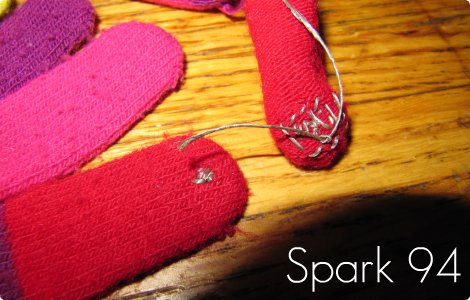 Have you ever tried to use your iPhone while wearing gloves? It won't work, unless of course you stitch some conductive thread into your mitten!
This remarkable insight, and many more of an equally Canadian perspective, are the fodder of Spark, a weekly radio show cum podcast cum blog produced by the CBC. It deals with technology and trends that impact the way we live, work and communicate. The hour-long show is entertaining and evocative, trendy and thorough, interactive and insightful, and it has quickly become one of my favorite pieces of "distinctively Canadian content".
The way I consume Spark, as can you, is in itself a sign of how much technology has changed the way we live. Although Spark is still broadcast at a specific time, on a specific frequency, on FM, I just listen to it whenever I feel like it. I have subscribed to its podcast through my Logitech Squeezebox, an amazingly powerful small device linked on one end to my stereo, and on the other into my home WiFi. Thanks to Squeezebox, I can listen to any streaming or podcast content in the world, and easily keep in touch with Swiss news, Argentinian tango and San Francisco Big Band swing. Yes, sometimes technology is magic!
Labels: Canada, technology
# posted by Oli : 21:08


Subscribe to Posts [Atom]


